Saturday, May 7, 2011


Things to know when climbing a mountain:
                              The 2nd tallest mountain in Africa is not going to be easy to climb
                             Even if the mountain sits on the equator, it will be frost-bite inducing, can’t feel your face, unbearably freezing that the top
                            Therefore, you should probably plan this trip in advance and pack accordingly
                    You WILL need a guide, a cook and a porter, unless you are a fool or an outdoor stud, you WILL need them

                            If you push through all of it, the feeling when you reach the top as the sun rises over Kenya, WILL be worth it.
With that being said I ignored my own advice (obviously … except for the guide part) and decided a few days in advance that I wanted to climb a mountain. Although I was totally unprepared for what climbing a mountain entailed, it was one of the more exhilarating (and exhausting) experiences of my life. Strangely enough, I didn’t bring all that many pieces of winter clothing with me to Africa. Luckily, my friend Jack climbed the mountain a few weeks earlier and lent me all of his clothing, which would come in handy in the following days.
                It wasn’t until we reached the mountain after a half day of traveling across the diverse terrain of central Kenya that I realized that this wasn’t going to be a walk in the park (bad joke, it’s called Mt. Kenya National Park, so in reality it was a walk in the park… pity laugh? Thanks). Horrible jokes aside, we entered the park and began our first hike. We hiked on a path through thick forest and wilderness that ran a small ridge overlooking a giant valley. Our guide, Isaac, porter- Boniface, and cook Harrison explained the bird life and plant life as we walked upwards and onwards. We passed the equator, marked by a shoe-sized rock with a line drawn across it and the word “ecuater” scratched in it. Some would say that it was anti-climactic, me, I thought it was absolutely brilliant. We crossed elephant and buffalo tracks, both of which we were assured were down in the valley by now as the sun was too hot on the path. Then we crossed hyena and leopard droppings, which Isaac told us was very old… looked pretty fresh to me, but then again, I’m not an animal dropping expert. We reached our destination for the night called “Old Moses Lodge” and settled in.  Old Moses was a tiny little camp that was perfect for what we were looking for. Some would call it rustic, others would say it was disgusting, we thought it was perfect. If we were older and not living on peanuts for months at a time in Africa, sure, there were some improvements that could have been made, but at the rate that we were paying the guides and fees and expenses, we were happy that we weren’t eating the bark off trees and sleeping in a field. As soon as the sun dropped out of sight, the temperature did as well. It was quickly -5 degrees and WINDY. We tried to stomach the cold and look at the stars, but 15 minutes and 10 shooting stars later, it was too much to bear. We crawled into our sleeping backs and tried to get as much sleep as possible as we heard rats crawling through our room and who knows what type of animal howling outside.
                The next morning we woke up bright and early with the sun, scarfed breakfast and broke out for our longest hike of the trip. We were scheduled for an 8 and a half hour hike that would take us from “Old Moses” to “Shiptons Lodge” which sat at 14,000 feet, right below the base of the summit. This hike was incredible. We hiked up hills, through streams, over rocks, under rocks… everywhere you could imagine. We passed through fields, overlooked gorges and valleys, had lunch on a cliff overlooking a valley with a view of the peaks that I will never forget. 


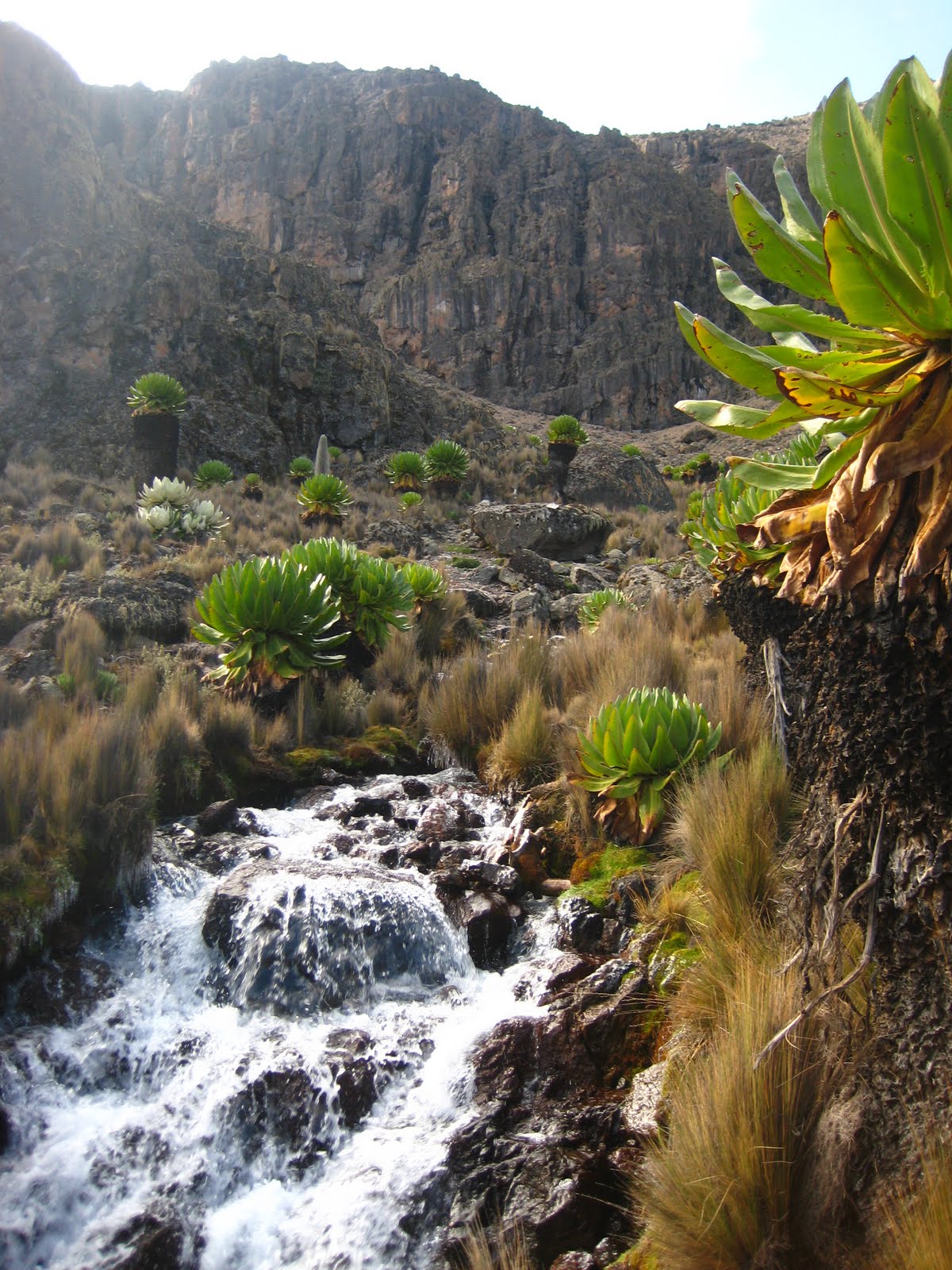
As the elevation changed, so did the scenery. It was a constantly evolving world that produced plants and animals that don’t, and can’t, live anywhere else in the world. We saw trees that looked like they were dreamed up by a director of a science fiction movie and a huge valley, with a stream dissecting it that guided running water, screaming downhill as far as the eye could see, until the mountain blended in with the flat land and the towns that sat at the base. It was the type of view that would make an atheist believe in God. That something so perfect had been created could not have been a mistake. As we walked, we learned about the mountain, learned about Kenya and even picked up some Swahili along the way. As we got closer to Shipton’s, the views got better and better and better. The air got thinner and every step became more difficult. It also gets a little steeper, so every step makes your knees tremble and your lungs burn. When we were about 50 yards away from Shipton’s, we contemplated giving up and sleeping  where we stood. We toughed it out and arrived at the doors of the lodge at around 4:30 pm, layed down in the incredibly uncomfortable (felt like clouds at the time) beds and rested for a short period after the 9 hour hike. After cup of scalding hot tea (or 10) we sat outside and stared up at the summit. I must have said at least 32 times, “there is no way we are getting up there tomorrow. How in the HELL do you expect me to get up there?!” I still can’t see how it is possible, even AFTER I did it. We spent some time with our fellow travelers (a British couple who were living in Christchurch, New Zealand and had moved only a few short weeks before the earthquake there, and a couple of American guys, working in Nairobi who were taking a weekend away from the wife and kids) and had an early dinner. With the onset of altitude sickness and a 2:30 am wakeup call, followed by a 3 hour hike up to the summit for the sunrise and a 4-6 hour hike (depending on pace) back down the mountain, we decided to call it an early night. I use that as an excuse because Lord knows that I wouldn’t have made it up much later, even if you paid me. We were exhausted from the day and despite the -20 degree weather and howling wind, I passed out, wrapped in my friend Jack’s sleeping bag, winter hat on my head, 4 layers of shirts and coats, 3 layers of pants, 3 pairs of socks and a pair of gloves on. The equator is hot?
                It is pitch black and my phone alarmclock is going off. 2:30 am on the dot. I almost fall out of the top bunk of my bed (heat rises, says Isaac, try to sleep on a top bunk… pshh, what heat is there at -20?) and stumble towards the door. Breakfast is crackers and popcorn, but there is tea and coffee, which at this point is all that really matters. Breakfast is a blur and getting ready is non-existent. There is no shower and I am already wearing all of my clothes. I grab my camera, water bottle and other essentials and we start our vertical trek. I don’t have a flashlight and I think to use my cellphone light… its all I have. In retrospect, I see why Isaac was laughing, we were crawling up rocks, using your hands, in the darkness, where was I going to hold it, my mouth? The guide scrambles through the other crews and comes up with a headlamp that probably saved my life. We set out in the darkness, 5 feet ahead of us is all that we can see. It was probably better that way, because if I had been able to see where I was going, I probably wouldn’t have gone. Our pace is slow, but that is natural as amateur climbers are scaling the 2nd highest mountain in Africa, at 3 am. The gravel beneath our feet is ice cold and every once in a while, a microscopic avalanche begins under the weight of our shoes as the gravel loosens, nearly sending someone on their butt and sending the tiny rocks into the abyss from which we came. It begins to get lighter and our guide tells us that we are getting close. I wrap my face in an extra shirt, but the air is so thin that I decide the freezing cold wind is better than making the intake of oxygen any more difficult. We reach a point where the path ends, and boulders and rock face stand in our way,only a few hundred yards away from the top. The sun is beginning to come out and we have a little ways to go. We are going to have to hurry to make the sunrise. We climb up the rocks, scattering across icey faces and moving rocks as we get near the top. We hear the voices of our fellow travelers. There are clouds whipping around below us (yes, below us) and it blocks the sun, giving us a precious few more minutes to summit. There is an 8 foot rock standing between me and the flat surface of the top of a mountain. I take one step up into a hole, give a little leap and do a pull-up, getting my chest, then leg, then body up over the wall. As soon as Isaac and Nikki follow, the sun peaks out from behind a cloud and…. The sunrise from a top of a mountain. 


The adrenaline rush from standing on top of a mountain is INDESCRIBABLE. You look over where you came and you have a feeling of a commander of a conquering army, a king overlooking his subjects. You realize that every step you took in your $5 Target boots that felt like you were walking barefoot (okay, that part is my fault, but seriously…. Mountain climbing in Africa… didn’t really see it coming), every time your knees felt like they were going to buckle and you couldn’t catch your breath from walking up a tiny little hill, was worth it. We were joined at the top by our two fellow groups as well as a group of British soldiers, huffing and puffing as they came up to the top from a different route. The wind whipped around, increasing the fear of falling off a mountain and the weather was colder than I’ve ever felt in my life…. Including my Freshman year at Madison. We took pictures with the Kenyan flag on top, the sunrise, the other peaks, the clouds from above, and ourselves, but none of them do the scenery justice. It was the feeling. The smile. The adrenaline that made you forget it was 6:30 am and it felt like you had been hiking for as long as you could remember. It was that feeling that powered you down the mountain, knees on the verge of giving out, wanting to sleep, wanting to shower, wanting to eat, wanting to sit down for 5 straight days. But that feeling. You could run back to Nairobi. You could swim back to the United States. You could run into the valley at the bottom of the mountain and find an elephant and take it down with your bare hands, carry it back and eat it (okay that last one was a little too much, but you get the point. I’ll leave it at that.) It was an incredible weekend, one that I will treasure forever. And once I’m an old man, looking back on the things I’ve done (23 is old, but not retrospective old… I’m still invinvible…)  the memories of the scenery and of the mountain itself will probably fade away.  When the time comes that I find myself relying on the pictures I have taken to recall the places and things that I saw, I will never forget the feeling of standing on top of a mountain as the sun greets the African plains.

Yep... I'm staying longer....


I know this might come as a shock to you, but I am extending my time in Africa. I was supposed to be here until April 27 which quickly became May 15th and now I am finalizing my plans to stay here until May 25th. I would stay longer, except the money is going to be gone and as much as I love living the lifestyle of a Kenyan, I’d rather avoid the whole zero money to the name, rob someone for your lunch deal. So there it is. I am coming home…. Eventually. But I’m going to ride this sucker out until the last possible minute.

Who cries for an orphan? When tears are streaming down his face, who will tell him that everything will be okay? When he stumbles and falls, who will pick him up, dust him off and put him back on track? When he succeeds, who does he have to share his successes?
Orphan. A simple word whose meaning  can never truly be summed up. Faraja, like many other children’s homes throughout the world has taken on the role of primary caregiver to children who have never had role models. And in what should be the most dreary and depressing places in the world, hope springs eternal.
My time at Faraja has been a rollercoaster of emotion. I have had countless experiences that I will never forget, some I will treasure and some I will be unable to forget regardless of how hard I try.  The time I have spent here has been a swinging pendulum of feelings.  The days are filled with physically demanding labor in the morning and with mind-numbing work on grant proposals and fundraising in the afternoon. You feel like no matter what you do you can never make a difference. You lay in bed at night, restless, unable to sleep, filled with uncontrollable unease and helplessness.  Even if you help these kids there are more, in Ngong, in Chicago, spread across cities and continents that go unnoticed and unhelped… but you have to try. You wake up and resume work but your hardest efforts are washed away like a sandcastle on the beach, as a wave formed from a child’s tears, crash upon your shore. She is crying because the house can’t afford to feed her lunch and you are devastated because no matter how hard you try, it’s just not good enough. As quickly as the tears formed in her eyes, fortunes can change. A donation, an email response, a conversation sparks a new lead and suddenly things look up. The next day is filled with the simple joys and small victories-- the tears have turned to play and laughter.  From chasing chickens who have escaped the pen with Kepha to eating githeri that I made, with kids-- who appreciate it no matter how poorly I make it-- the feeling of helplessness dissipates and every little decisions seems to be a life altering action in the lives of these children.
        I have become so attached to this place that my impending departure feels premature.  I feel at home in a house that is the polar opposite of the one I was raised in. I am now referred to as “kaka Ben” which means “brother Ben”, by a family that I have almost nothing in common with. I’m here to help--that is, and always will be the case-- but every passing day it feels less and less like I came to volunteer and more and more like I am doing my part to make the machine that is Faraja, run. It has become a family unit for me and their success is my success and their stumbling blocks are mine. I have no idea how I am going to say goodbye. But I know that eventually I will have to. For now, I’m just going to continue soaking up every second.

Let's Remember What's Important Here....

Let’s be honest with each other. It’s been WAY too long since I’ve focused my energy on matatus… I’m still staying focused and playing my position, waiting for a conductor to notice my natural skills in the matatu business. So far, I haven’t even gotten a nibble, but I’m gaining experience every single day that I believe will someday turn me into the best (and first) white matatu conductor in Kenya.
                Exhibit A: My friends and I were coming back from the elephant orphanage (place where you get to see baby elephants get fed and play from a distance of about 5-10 feet with no barriers besides a piece of string… but let’s stay focused on what is important here) and we crammed all 10 of us into the 14 person matatu that already had probably 8-10 Kenyans inside.  I jumped up in the front seat next to the driver because I saw the seat was open. We drove for about 15 minutes back towards Karen (town where we transfer matatus) before I suddenly smelled a really funky mechanical smell that didn’t sit well with me. It carried on for a few minutes; and as we dropped off one of the passengers and took off back on the road, a thick black smoke started coming into the cabin, right from under my seat… where the engine is. There is a spark that comes from the ignition, where there are two cut wires that the driver rubs together to start the car (think “Gone in 60 Seconds”). I scream at the driver, not taking any chances with the language barrier “WAY! SIMAMA SASA!!” (Hey! Stop right now!). The driver looks at me and realizes what is going on and swerves to the shoulder and I start telling all the white people that I am with to get out of the van! Even the Kenyans realize this is a miserable situation and there is a rush to get out of the matatu that resembles the stampede scene from the Lion King. The driver lets the van sit until the smoke clears (literally) and tries to restart the engine. It doesn’t work. The conductor asks me to help him push the matatu. Here I am, running down a major road, in sandals, pushing a dead matatu with the conductor as cars are whizzing by, half of my friends are sitting in the backseat and half are standing on the side of the road. I am adding this to my conducting resume. Once the car is in motion, the engine starts up again and stupidly we get back in thinking the adventure was over. We get about 5 minutes down the road when the engine gives out again. This time the conductor flags down the next available matatu and pays our fare to where we were planning on going. The driver says he can’t fit all of us so Bud, Abi and I stay back to wait for the next one. The driver asks for a push and me and Bud help him run down the road pushing the matatu again. He gives us money for fare and Abi flags down a matatu which gets us where we were going without incident. Another day, another adventure.
Exhibit B: It was midday and my roommate Portia and I were in Karen for some errands. We were waiting at the bus stop for a matatu when an empty one pulled up and asked if we wanted a ride. He said it would be 10 shillings (13 cents) to get to Ngong, and seeing as it was the cheapest fare I had heard of, we took the ride.
 Now, I know what you’re thinking, good idea getting into the one empty matatu that none of the Kenyans got into, the one that offered you 10 shillings fare and probably candy as long as you got in his van. Whatever, he told me he knew my parents, so I knew I could trust him…. That’s beside the point. This was probably the smoothest and safest matatu ride that I’ve been on, it was empty and cheap because it was off hours and no one rides the matatus away from the city during business hours. The reason this story is included is because it was invaluable matatu experience. I was finally one on one with a conductor and I got to ask him every question I wanted to!
I asked him how he remembered who had paid and who hadn’t paid because there is seemingly no rhyme or reason to when they ask you for money. I asked him how he remembers who he owes change to and how much change he owes each person, because sometimes they give you change straight away and sometimes they wait until you exit the van, depending on how much money they have in their possession at the time of payment. I asked him how he keeps track of the money. When we were stopped for a routine check by the police, I noticed that he didn’t bribe them, I asked him how he knew when to pay the police and when not to… to that question he responded “I don’t know what you’re talking about”… well played. I asked him if he had ever fallen out or had missed the step running to jump in. He rolled up his sleeve and showed me a scar, smiled and said “yes”.  I can’t disclose the answers to the other questions otherwise I would have to kill you, but let’s just say I picked up a few tricks of the trade. As we arrived in Ngong I thanked him for the ride and he laughed and said that he had fun. Now I know the ropes, have been proactive in matatu situations and have a feeling that I could handle the reigns. Now all I need is a chance to shine…

Wait?! I'm in Africa?!?!?!


           There are moments in my life that snap me out of my bubble and shake the foundation of my African world. My roommates and I call these moments “Wait, I’m in Africa? ---moments”.  You never know when one will hit, and when they do, they are a source of exhilaration and sometimes a tinge of panic, depending on how safe the situational source of the emotion is. All of my friends here have had them, to varying degrees, and they are usually coupled with great stories. 
            My most recent “W.I.A. moment” was an exhilarating one, sans panic, despite the Western standards of safety it most likely disregarded. I was on the back of a pikipiki (a small motorbike used as a taxi to get to relatively close destinations or pass on routes that cars can’t manage… this trip was an example of the latter). We were driving on a nonexistent road overlooking Maasai Mara on a beautiful sunny day. I thought to myself as I looked over the wildlife infested, rural African, no-civilization-in-sight expanse of land with my arms clinging to Nikki for my actual life, while she clung to our driver, Kamau, for hers… ‘I am really in Africa right now, I came here by myself and I am living here, what was I thinking?!’ It’s not a bad feeling… the what was I thinking part… because I am enjoying my time. At that split moment I just couldn’t believe my decision making skills.
             We were making the trek out to our friend, and soon to be Mombasa travel companion, Jack’s placement in Sikeri (no idea how to spell it) which is located in the Maasai, about 30 minutes away from Ngong as the crow flies, just over the Ngong Hills. That 30 minutes quickly becomes a 2 hour journey because the roads are crater ridden and at some points impassable. We actually had to get off the motorbike and climb up a hill, then get back on the bike and continue because we couldn’t pass on the road. On a scale of smoothness from a baby’s bottom to an emergency landing on an airplane this road was more cracked than a pubescent boy’s voice trying to sing Alicia Keys (what up Birthright crew!) Anyways, on the motorbike, we passed over the Ngong Hills, out of the city and into the country. The hills are a natural separation from where Nairobi ends and The Rift Valley begins. We were coming down the hills into the heart of the Maasai territory, with Acacia trees lining the “road”, when it hit me. The feeling of “wait, I’m in Africa!”
When we arrived in Sikeri, we spent some time taking in the slow paced lifestyle of the country people, breathing in the smoke and pollution free air and killing time by watching the sheep pass, instead of listening to the argument outside our window. It was a different world… even from the different world that I am currently living in. On the ride home that evening, as I was walking up the hill following the motorbike, I looked over the land, Ngong Hills in the distance, trees and valleys and red dirt roads as far as the eye could see, and  I thought to myself ‘Wow, I’m in Kenya and there is nowhere else I’d rather be”. It wasn’t the first time I felt that way, and I’m sure it won’t be the last.